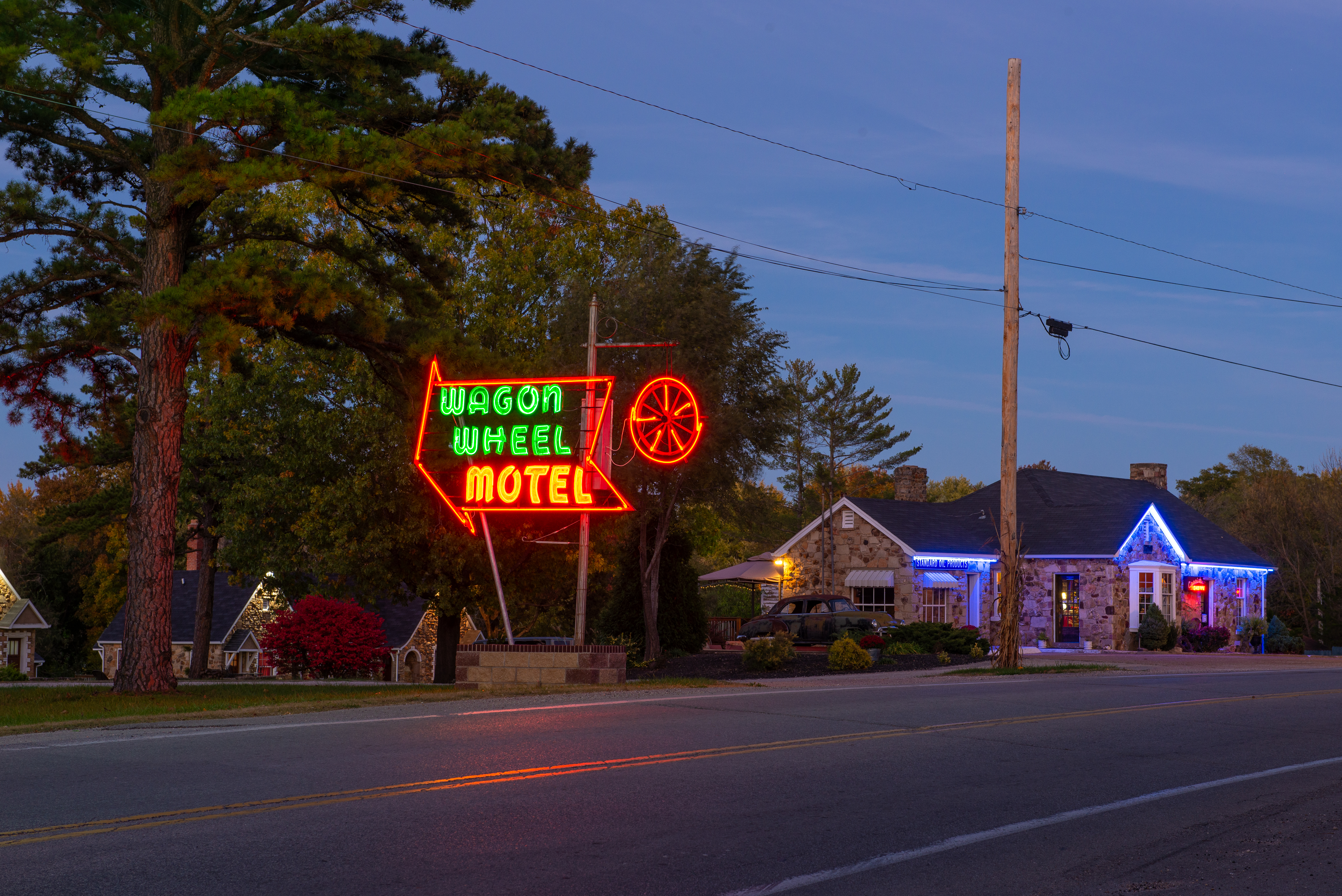
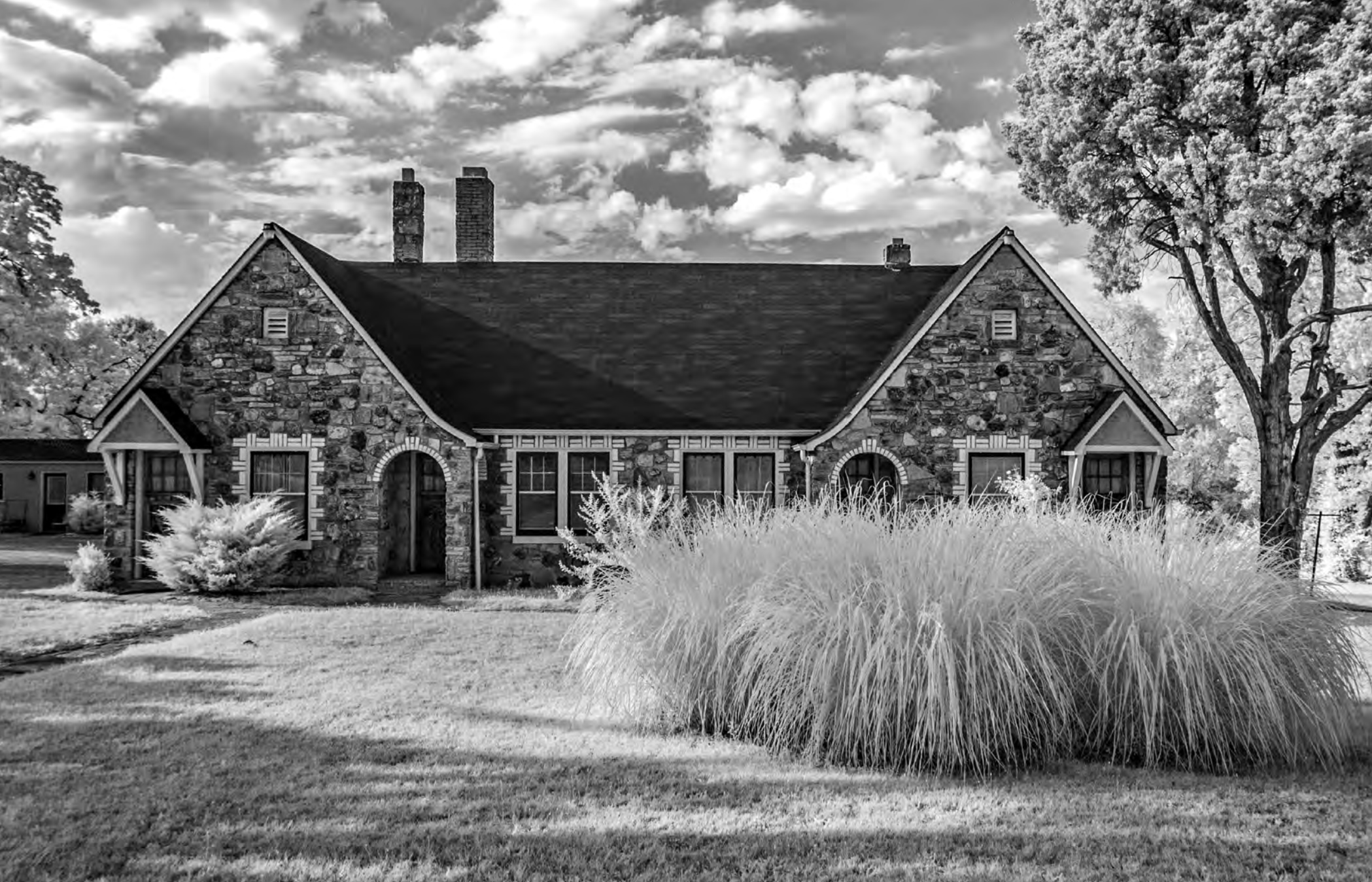
Nestled into lush greenery along old Route 66 is a row of English-style cottages that seem straight out of a storybook. The quaint stone cabins, adorned with whimsical masonry and steep, peaked roofs, are not freestanding but rather conjoined into three broad, single-story bungalows. The enchanting venue rests peacefully in the tranquil setting, seemingly untouched by time, evoking a quiet, Old World charm. The history of this place is as intriguing and humble as the individuals who have cared for it over the years. This idyllic lodging, now listed on the National Register of Historic Places, is none other than the Wagon Wheel Motel in Cuba, Missouri.
As automobile travel grew exponentially in popularity as the 20th century pushed on, highways became lined with primitive tourist camps, which in turn gave rise to tourist courts during the 1930s and '40s. Pretty cottage courts sprang up, offering all the comforts of home. And even at the time, the Wagon Wheel was one of the finest.
The 1941 AAA Directory of Accommodations called the Wagon Wheel Cabins a "home away from home, with cottages far enough removed from the highway to ensure quiet rest. An exceptionally fine modern court of 14 stone, insulated cottages..." A matching stone café and a tiny gas station were situated close to the highway, the better to catch the motorist's eye. Every service and amenity that a tired traveler could want was conveniently waiting at the Wheel.
Meanwhile…
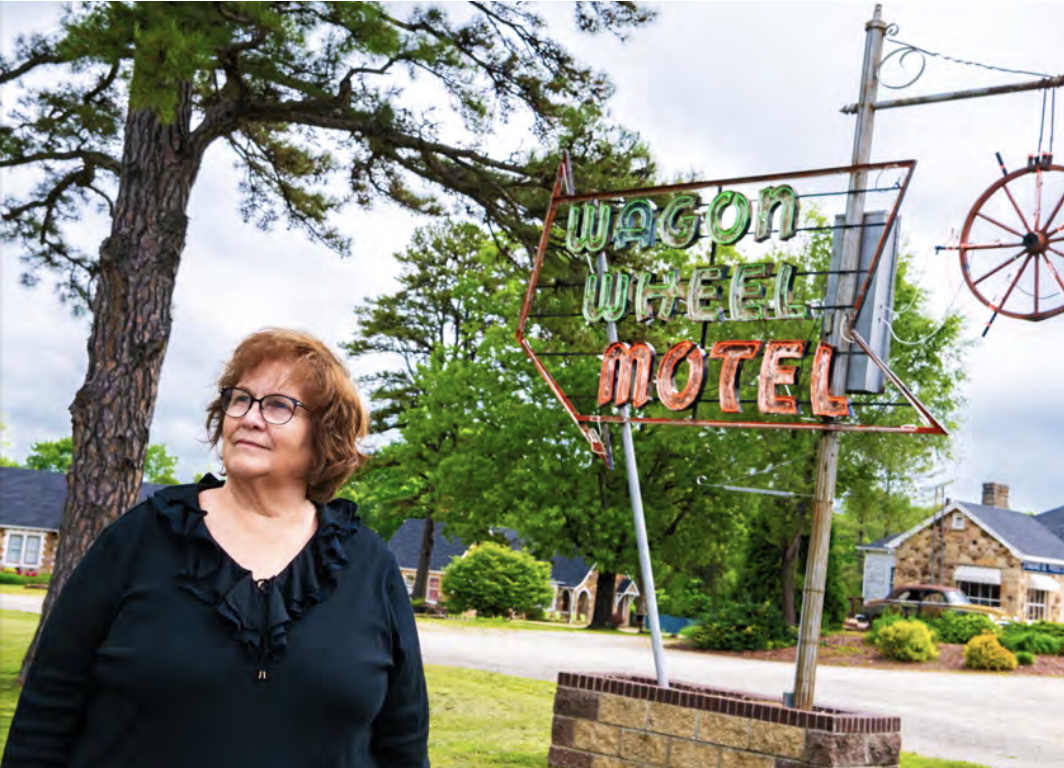
In the mid-1940s, the Wagon Wheel changed hands, about the same time that, up in Iowa, a young G.I. named George Caspers married 19-year-old Erma Schlotterbeck. George and Erma started their family at Anamosa, Iowa, on a cattle farm. A daughter, Connie, was their second child of eight. This girl-child learned how to work hard, ride a horse, and make a home pretty and welcoming. But even Connie could not know how interesting her journey would be. "My father was a hard-working World War II veteran, a SSGT in the U.S. Army and a Purple Heart recipient, who I believe suffered from what they now call PTSD," Connie explained. "My mother worked at home taking care of everything for the eight of us, which I never fully appreciated until later years."
One summer, brothers Les and Ray Echols from Cuba, Missouri, arrived in Iowa to work at the mill on the Caspers' farm. There, they met and eventually married sisters Connie and Riva. At the age of 18, Connie moved to Cuba with her new husband. At that time, the Wagon Wheel was immaculately maintained and still enjoying decent business, with rooms renting for about $17 per night. Connie always loved the look of the quaint stone buildings. Little did she know that 40-plus years later, she would rescue an unkempt older version of the motel.
Life and Work in Cuba
Les worked as a farmer and logger, and Connie put her domestic arts to work. Two children, Angela and Greg, were born of the marriage. "I always worked hard for things I wanted and believed in, and the welfare and happiness of my family was always number one on my list," Connie emphasized. Together, she and Les restored a historic farmhouse, and she learned some construction skills to add to her arsenal of talents.
She first worked outside the house at Cuba Nursing Home, and next at Whistles, a niche shoe company. "My favorite job was [at] the shoe factory in Cuba. I helped with making samples, stitching, and setting piecework prices for fourteen years. Sewing was also something I always enjoyed. I made shirts, kids' clothes, and prom dresses, and later my daughter's wedding dress and bridesmaid dresses for numerous weddings."
After Whistles closed, she worked at Paramount Cap in Bourbon, eleven miles northwest. "After Les died in 1993, from a long illness, I quit the hat factory to open The Wildflower, a florist [shop], in an older building which I remodeled twice over fifteen years. During those years I thought I had learned some about construction. It was nothing like restoring the Wagon Wheel!"
After the last owner of the Wagon Wheel passed away, Connie drove through the grounds, imagining what she could do with the historic gem. "I had always thought the stone buildings were great, but it was so overgrown that you didn't get a good view of it," she explained. "I never gave it a thought till I went to see what they were going to do with it." Then, the idea of a grand restoration took root as she contemplated the motel's long history.
How the Wheel Got Rolling
Scottish-born Robert Martin and his wife Margaret arrived in sleepy Cuba in 1934 for one purpose — to build one of the finest tourist courts on Route 66. The area's economy had been stagnant since the early 1920s, but Cuba was beginning to come alive with the golden touch of the U.S. Highway 66 flowing through its environs. New cafés and stations were opening at "the Fourway," the main intersection, and the townsfolk were hopeful.
The Martins purchased two parcels of land totaling eleven acres on the east edge of Cuba. The larger parcel gave them a spacious area for their cabins. In 1936, on the adjoining small parcel, they would build a gas station and a café to lure travelers to fill their gas tanks and stomachs. Well-known area stonemason Leo Friesenhan was the Martins' choice for the work. The cabins were constructed of Ozark fieldstone, built parallel with the highway, and joined by covered carports into three buildings, offering ten guest rooms. They opened their doors in 1938. The Martins kept Friesenhan busy for several more years, adding outbuildings and converting the carports into four additional rooms to accommodate increasing demand.
But as they expanded their court's capacity, the Martins set their sights on a lodging complex in a larger city. With plans to buy and expand the Pierce-Pennant Tavern in Rolla, 24 miles east, the Martins were ready to sell the Wagon Wheel Cabins. They found buyers, Clifton and Beulah Speer, and Edmund and Violet Koebelin, in 1946. The two couples may have purchased the Wagon Wheel as an investment, or discovered that they didn't care for the business, but they quickly resold the cabins a year later to John and Winifred Mathis for $68,000, a large sum at the time.
The Mathises renamed the lodging the Wagon Wheel Motel, and John designed the iconic neon sign, which still stands, to announce the change. During their tenure, the couple added two new buildings, one of which became four additional rooms, boosting the total to eighteen, and they joined the Best Western Motels referral network, which rated the Wagon Wheel Motel as one of the finest in Missouri. The '40s through the '60s were good years for the Wheel, with thriving business and room rates at an economical $17 to $19. With Fort Leonard Wood opening in 1940 just an hour south of Cuba, military traffic moved up and down Missouri 66 until it was replaced by vacationers in the post-war travel boom. Around the Fourway, new businesses opened, while others expanded to accommodate the influx of tourists.
Pauline's Forty Years
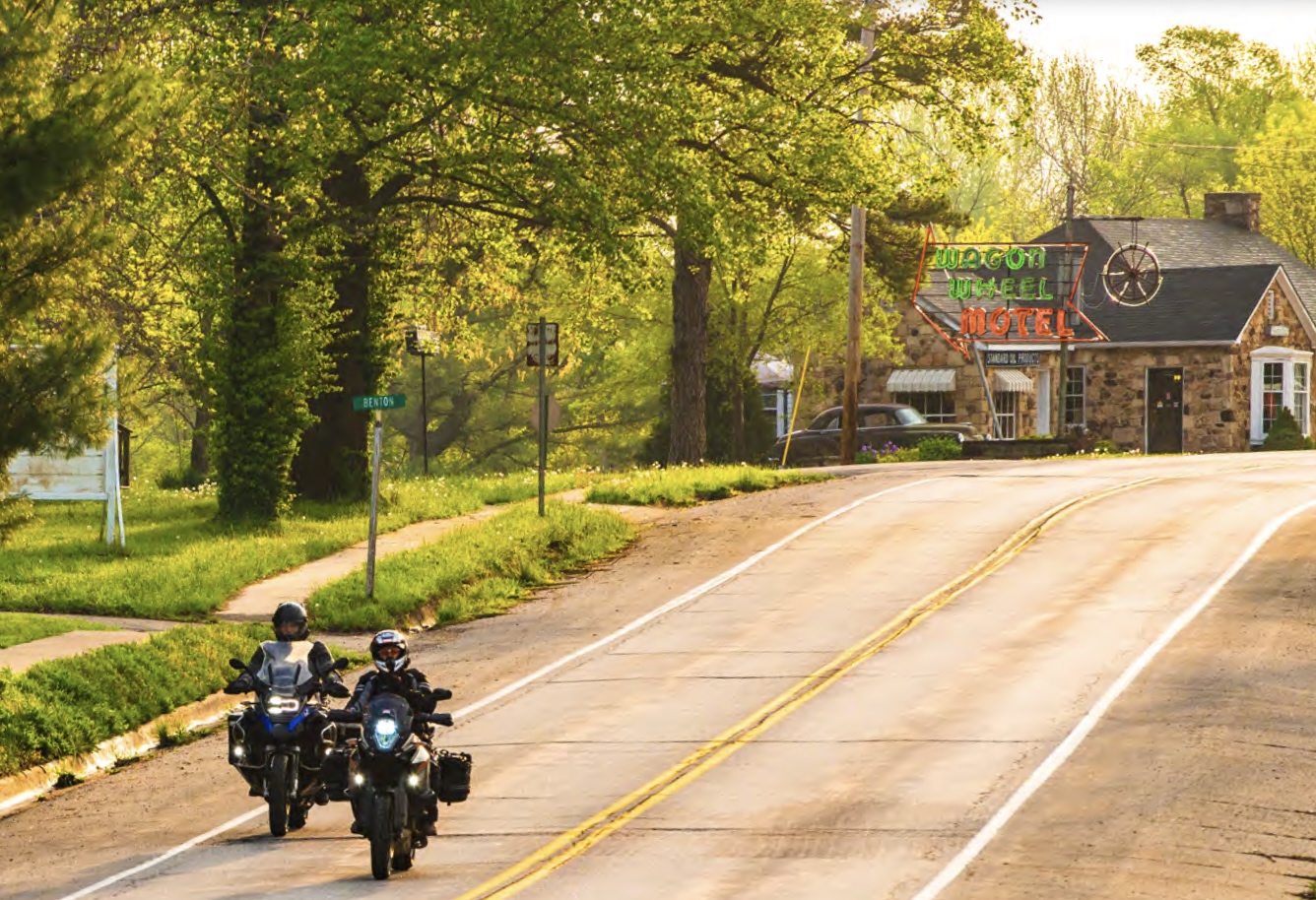
In 1963, Pauline and Wayne Roberts of Aurora, Illinois, met the ready-to-retire Mathises and warmed to the idea of buying the Wagon Wheel. Wayne remained in Aurora working two jobs until his retirement, while Pauline moved to Cuba to operate the motel. Wayne made a weekly trip to Cuba for the next six years. Roy Mudd, a mechanic reeling from a divorce up in Illinois, somehow made his way to Cuba, where Pauline hired him and let him stay at the venue. Roy showed his gratitude by handling the mowing, the maintenance, and any other chores she would assign.
Wayne died of cancer in July 1980, the same week that a tornado took the roof off one of their buildings. Heartbroken, Pauline soldiered on with her devoted assistant Roy and a female employee, Liz Simpson, who stayed for the next twenty years.
Eventually, Roy got a job at Schwieder Ford in nearby Bourbon, but he continued to take care of the Wagon Wheel. Alderman Jeff Bouse was just a boy who lived across the highway from the motel when he started hanging out there. "My dad and Roy were friends, and I started helping Roy with the yard work," Jeff remembered. "He had an old Ford tractor and numerous cars that he enjoyed working on."
Pauline, at age 73, married Harold Armstrong in 1988. Soon, changes — and not for the better — were noticeable at the motel. Armstrong didn't believe in wasting good money on maintenance; Route 66 was suffering from the worst years of its decline, and the City of Cuba had lost industries. Pauline and Harold took in anyone who had a few dollars. Police started making regular visits in response to all the complaints, and respectable guests wouldn't stay even if they wandered off the interstate. This chapter ended with Pauline's death in 2003, followed by Roy in 2005 and Harold in 2008.
Connie reflected on Pauline's forty years of ownership: "I found out how hard she had worked and that she also had the bossy gene, which it takes, and why the place got so rundown. I certainly can see why they did weekly-monthly rentals when that is all the calls you get in winter months, and times like these. Pauline was the homeless shelter in Cuba for years. She said, 'People need a place to stay and I don't need any more money.'"
Less than a year after Armstrong died, Connie purchased the complex from his son James, who was still renting rooms at $11 per night. "They were renting it up until the day I bought it. I kept it open but changed who was allowed to stay — only single working guys, no kids or women as it wasn't safe. It has never closed, ever, in 84 years," she emphasized. Wagon Wheel neighbor Jeff Bouse was a city employee then, and when Connie needed the utilities transferred into her name, news traveled fast. "I was tickled to see Connie take it over, because, for me, it's a special place," Jeff said. "And Connie makes everybody feel at home there." Connie would indeed make everybody feel at home, and now she owned the whole complex — the historic motel, the old Wagon Wheel Cafe, and the tiny gas station.
The Tangled History of the Cafe and Station
Although the Martins built the entire complex, the pair largely focused on opening the cabins by 1938, and put their energy and time into this particular goal. In an effort to divest their time from the other business entities, they signed a five-year lease with Marathon Oil, but recruited refinery worker Joe Slowensky and his wife Clara to operate the station and the café. This decision began a complicated litany of operators, owners, and oil leases that might require a Venn diagram to understand.
Flash forward to 1950, Sadie Mae and Bill Pratt acquired the café and made it one of the most popular eateries along Missouri Route 66. But with four-lane construction underway east of town, the Pratts wanted to purchase land there for a new restaurant. In 1956, it was the end of the line for the Wagon Wheel Cafe when the Pratts sold it to a medical office, which was followed by a stream of various tenants. The building never held another eatery.
Connie's Restoration
Connie knew just what to do with that café building — she would clean it up to open a new business, Connie's Shoppe, just in time for Christmas shopping. "Good friends pitched in right away, while seriously doubting my sanity, I found out later. When I told my mother what I'd done, her reply was, 'What the hell's the matter with you? Are you crazy?'" Determined to get the job done, Connie and her crew removed partitions, a dropped ceiling, and layers of flooring, revealing the original beams, hardwood flooring, and stone fireplace. She sold her florist business, keeping the gift inventory for the new shop. It had been a mad rush, but the shop was open on schedule. However, the restoration had only just begun; before tackling the arduous task of restoring the motel, there was just time over the holidays to take a breath.
The motel's restoration proved challenging, even for Connie's capabilities and perseverance. The gas tanks needed to be dug up and hauled away, and soil and building materials tested. The basements, attics, and garages were full of "years of hoarded junk." Overgrown vegetation needed to be cut. The frame structure surrounding the station was torn off and became bonfire kindling. As for taking on such a demanding project, Connie explained, "I always enjoyed a challenge and a chance to be creative. Breaking horses and barrel racing in my teens … learning to play a decent game of golf. Then the florist business." But the Wagon Wheel project may have been more daunting than she expected.
New plumbing, wiring, and HVAC were installed, and new beds, modern amenities, and Connie's decorative touches readied nineteen rooms for a new generation of guests. She followed the U.S. Secretary of the Interior's Standards for Rehabilitation to preserve historical elements and materials and to maintain the original purpose of the site. Grant assistance from the National Park Service Route 66 Corridor Preservation Program in 2012 also aided the restoration. "One [of my] brothers was my go-to person if I had a building question; another brother was my mechanical advisor. They gave me the confidence to stick to my ideas," Connie laughed. "I had lots of support from [sister] Riva, including help with every brainy idea that I thought I could do myself, from staining windows, laying floor tile, to hanging curtains."
As boxes of registration cards and checkbooks were unearthed, the sisters wanted to make sure that the Wagon Wheel's history, as well as its renaissance, was properly documented. Riva organized the materials, conducted research, and put it all together in a cohesive narrative. Her book, The Wagon Wheel Motel on Route 66: The History of a Route 66 Icon, was published in 2011.
Support came from a new source in October 2011 when Connie met lifetime local farmer Charlie Yowell. "When Charlie and I got together in 2012, we were cutting firewood for spending money. The next year things started to turn around, even with another year of construction. I never could have kept up without him. [My family] are all such a big help when I need them," Connie said. "It's not the Marriott, but we have white linens and the cleanest rooms in the area, with beautiful outside areas to relax and help compensate for the historically small rooms. We try our best to keep all the 'historic' things working all day every day!"
Since opening in June 2010, registrations read like a Who's Who. Authors, photographers, and musicians; filmmakers and documentarians; car and motorcycle clubs; tour groups; international guests; and the Oak Ridge Boys — four times. "We appreciate that many Route 66 enthusiasts traveling the highway make a stay at the Wagon Wheel a must," said Kim Roedemeier, Cuba Tourism Director. "We are lucky to have such a unique piece of history, such a quaint attraction, to draw Cuba as a destination." Cuba's downtown is compact and walkable, with other attractions within easy driving distance. "A variety of dining establishments are within walking distance, as are the historical murals, making this charming motel a great central location," added Roedemeier.
As she looks to the future of the motel, Connie remains optimistic. "I'm preparing to hand over the Wheel to the right buyers while it's still in prime condition. I'm confident that Route 66 will always remain a major attraction." For now, the Wagon Wheel Motel is ready to offer you a step back in time. The intriguing Connie's Shoppe always offers a fresh array of Route 66 souvenirs, antiques, and fun, quirky accessories. On a pleasant summer evening, you can view the property from the deck with a cold beverage in hand, or just sit back in a comfortable lawn chair as fireflies light up the night. Nineteen lovely, spotless rooms with historic touches, modern amenities, and fresh white linens offer rest and renewal for another day on Route 66. And the innkeeper is always ready to welcome you to your home away from home.