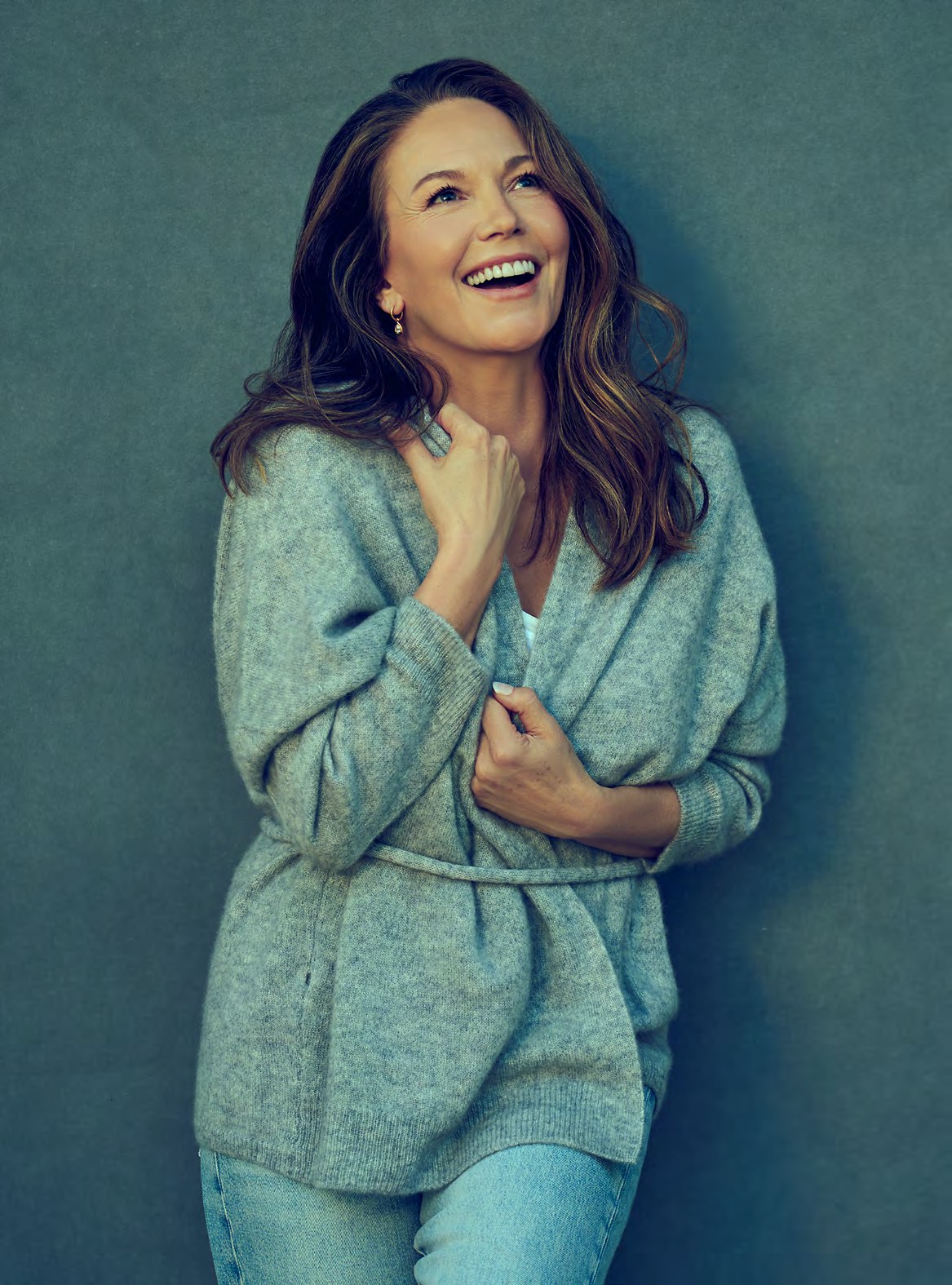
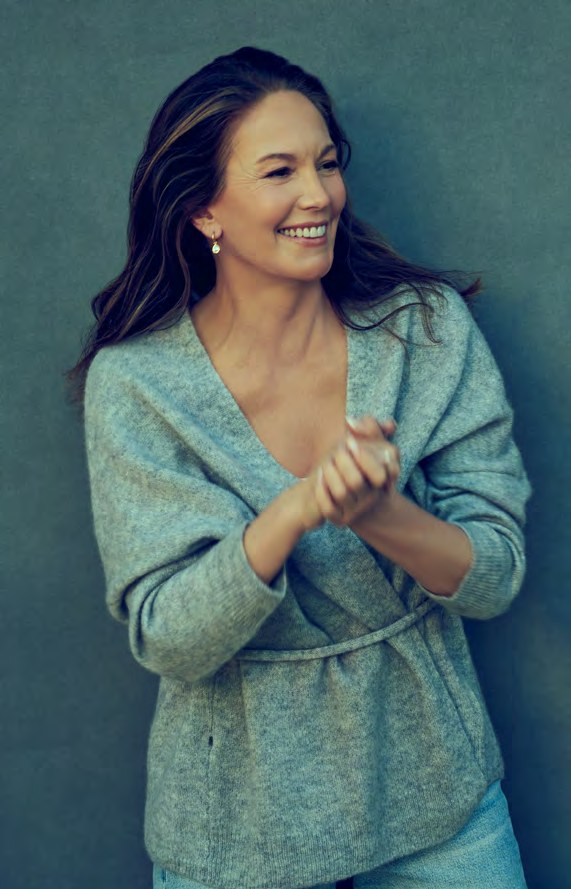
In this conversation, Lane reflects on a childhood split between constant travel, early professional demands, and complex family dynamics, revealing how those experiences shaped not only the actor she would become but the woman she is today. From behind-the-scenes stories on The Outsiders set to the quiet wordless eloquence she brings to The Perfect Storm and the transformative journey of Under the Tuscan Sun, Lane shares candid insights into her craft, life, and resilience. This is a conversation about the threads that weave a life into something extraordinary.
Your family background almost reads like a novel. You come from quite an interesting stock.
Yeah, and those are just the characters that I’m most familiar with personally. I mean, genetically, who knows how many people we’re all made up from, right? I mean, when you say stock, I think of epigenetics, and 11 generations is a big gene pool. So, who knows to what I owe my resilience or willingness to keep at something and find what it still has to teach me. You know, doing one thing for a long period of time is unusual in some ways, but not in others.
Besides coming from such an interesting family background, you were also on stage at just six or seven in Medea at La MaMa in New York City. What was it like jumping into that world at such a young age?
I got my first… I suppose you’d call it a job! Although at six it doesn’t feel that way. (Laughs) I turned seven before the show opened, so technically I was a 7-year-old when the curtain went up, but it takes so much time to prepare a play for presentation. I say about theater, you can’t have a miracle without a crisis, and I think theater is kind of for adrenaline junkies. Like, “Let’s put on a show, people will come, and we better have our act together.” Literally.
So true.
I mean, you’ve got to be of a shared goal mindset, and I loved that sense of community that I got from being a member of the La MaMa Theater Company in the early ‘70s. It was amazing, to be there, [to be] the child in their cast, whatever play they were doing.
Did your parents steer you toward performing, or was it something that grew naturally out of your environment?
It was sort of in the ethers. I don’t know how to put it in a better way. It was still lingering in my father and mother’s life, even though they weren’t married any longer, and I was a child of divorce from the get-go… but both of them still had a connection to showbiz, as it was referred to then. The joke was — and it turned out to not be a joke in the least, it was very tangibly true — it was better than daycare, or whatever after-school programs there might have been in public school in 1972. So, I gained a purpose, I gained an identity through being a responsible party in these productions of these plays. I had to stay in school and do my homework. And the people in the play, I was sort of envious of the adults, because they didn’t have homework, they didn’t have to go to school at eight in the morning, you know… so I was just this very tired little kid, in a lot of ways. But it did give me muscles, my brain, it gave me a sense of stamina that I didn’t even realize I was developing.
You definitely had such an unusual childhood, but that was a lot to juggle at any age, especially as a young child.
Well, I was very keen on attending to the wounds of both of my parents. I was the need for them to stay in communication with one another. I think they would have happily avoided staying in touch, but they had this rest-of-their- life job to do, which was to share a daughter, so I kind of felt like the apologetic bridge between them. I would go back and forth, and it was very awkward as far as the triangulation that would occur, and, you know, the cliche, “I would never ask you to choose which parent you want to live with, but who do you want to live with?” And I thought, “Wow! What an epic fail of role play of adult and child.” And so, in that way, it definitely tinkered with my understanding of what goes into [a] relationship. I mean, we’re all the walking wounded from our childhoods, it’s just about filling in the blanks of the details of what that is.
You were constantly traveling, performing, and spending time with adults. Did it ever feel like you were living in a completely different world from other kids your age?
I don’t really understand people that had these… summer for them was a verb, and to me, I just looked at people that had siblings or could go to the Christmas parties or whatnot. I mean, we had an extra show to do, you know? So, there was always doing the tours in Europe in the summer, and being away from both of my parents, all through most of what we call Europe and some of other parts of the world. I remember seeing the ruins of Baalbek and Persepolis in my schoolbook, in the classroom, with everyone studying about world history in our rather simplistic schoolbooks. And I wanted to jump up and down and say, “This is where I was this summer!” But I couldn’t, because I knew that it would make me a freak to the kids. So, I learned how to sort of… how would I phrase it? I mean, do you know your audience, or do you curtail yourself from your own sense of joy about things, because it makes other people uncomfortable? I should say it makes other fourth graders uncomfortable. (Laughs)
Most kids are figuring out who they are on the playground, and you were figuring it out on stage and on the road. Do you feel like it changed the way you see yourself — and maybe even the kind of actor you became?
You know, a trade is a lifelong sort of identity, when I think about people who are in various fields of endeavor. I find it interesting that in my line of work, I’m representative of whatever limitations I may have. I am a gender, I am a race, I’m an age, I’m a citizen of a certain zip code, you know. I do love, I don’t know if it’s anonymity, but it’s not having crafted, intentionally, anyway, too much of a [specific] persona. My father was of a different school of thought on what being an actor is. He did believe in crafting a persona, and to me, that was such an oxymoron. Is it another mask you’re supposed to present? As the “artist” or performer, or storyteller, or piece of clay that morphs into whatever role play is required to tell a story? The anonymity of the person that’s behind the proverbial mask is, I think, somewhat essential and a gift to both the recipient and the giver of a story. That’s the difference between being a celebrity and being a craftsperson, I think. It’s kind of a tightrope walk. I remember a small town I lived in for a while in Georgia, and there was a little company there that made signs, and their sign said, “A business with no sign is a sign of no business,” meaning, you have to promote or whatever. So, interfacing with a level of curiosity about who’s behind the proverbial mask is… the older I get, the more mysterious in some ways I realize life is.
You were 17 when you landed The Outsiders, working with Francis Ford Coppola and acting alongside a group of young actors — Tom Cruise, Matt Dillion, Emilio Estevez, Patrick Swayze, Ralph Macchio, Rob Lowe — who all went on to become huge stars. How did that role come to you, and what was it like stepping into that world as the only female lead?
Well, I had been hitting the pavement, showing up at random auditions, just because it was something to do after school. I was a latchkey kid. So, I’d find out about roles and show up at auditions or readings. It could be an orange juice commercial, it could be a play Rodgers and Hammerstein were auditioning for, it could be… well, it was only Rodgers then, but everything in between. I was comfortable with being uncomfortable.
Did you have an agent or were these cattle calls?
No, no, no, no. Back then, you’d hear about stuff, because there was so little of it going around. I mean, when the Time Magazine article was written [1979], it was because it was such a weird phenomenon to be having so many young people in cinema at that point in time. They were like, “Look at this strange phenomenon of all these very young girls who are the focus of these films,” so it was very anomalous. I had met Fred Roos because somebody had said, “You need to come to visit the Zoetrope lot, [Francis Ford Coppola’s film production company] and see how they do things.” And I must have been, I don’t know, 16 years old or something? So, when, maybe a year later, they were casting these movies, I basically got a call. By then I had already done, I don’t know, four movies or something, so maybe I had an agent. So, they knew that I could do it. And they knew that it wasn’t a risk that I couldn’t handle, what was going to be asked of me. You know what I’m saying? I had been tested, in a way, in terms of capacity, and being a team player, and having a bit of a reputation, like, “Is she crazy, or is she gonna show up on time?” They never know with actors, right? That’s why they don’t let you drive yourself to work, because they’re afraid you might not make it. They treat you like children all of your life, if you let them. (Laughs) But, anyway, all kidding aside, I had met Francis on the set of One from the Heart [1981]. He always had a very open-door policy about people coming through. So, just that one meeting, I think, Fred remembered me and said, “You know, we could just go to Diane and offer it to her.” I think that’s what happened, because I never read for it.
That’s amazing! The experience for the guys was a bit different.
Oh, their stories are legend. There was so much competition among them… who was gonna get which part, and all of that. No, I practically had an epidural.
Surrounded by all these guys, were you intimidated at all, or did you feel like you could hold your own from the start?
It was a strange hybrid of both. You know, there was only one of me. So, I didn’t feel like I had a bunch of siblings to be rivaling with in terms of attention, which I guess is something that you either want or don’t want, but it depends on your mood that day. You know, it felt like all of them and just me, meaning I needed to sort of keep my head down and not provoke anything that I didn’t want to provoke. Of any kind of attention, you know? I was a little bit of an introvert, I think. But I would show up to the, probably illegal, keg parties that were happening there in Tulsa, with all of these girls from Oral Roberts University. Those girls were all over. When they heard about these boys being in town, there would be a keg party, and I didn’t exist. It was all of them, and I just thought, “Wow, it’s like a smorgasbord and a feeding frenzy. I’m gonna go home, back to my hotel room, I can’t handle all this hormonal energy.” It was a lot. It was fascinating to be an observer of that, actually, and to see how the young men either stayed in character or were refining their characters, or breaking out, or forging friendships and buddy systems, and taking teams and, you know, staying in their “Soc” versus “Greaser” role, which was asked of us to maintain as much as we could.
Do you remember any behind-the-scenes moments that capture what that experience was like?
You know, there’s the epic story of Rob and Emilio, and I don’t know who all was behind it, but they somehow seduced the keys away from the housekeeping girls, and they got into all of our rooms, and they short-sheeted the beds, and put honey all over the toilet seat, and put Vaseline on the doorknobs, and wrote “Helter-Skelter” on my mirror with lipstick, and I was in shock. You know, I heard that at one point they were going to leave a fully loaded toilet behind, and I’m glad they didn’t do that.
That’s wild!
But it’s so fun, because I never got to participate — I didn’t get to go to summer camp, you know? I didn’t get to do a lot of things that a lot of kids did, so in some ways, I got to have it in Tulsa that summer.
Patrick [Swayze] was older than most of the cast. How did he fit into the group?
I think he was already married with Lisa by then. He was the upstanding, yet slightly enabling, older brother. He took on the would-be uncle role, and, you know, he took to that really well. And it was just adorable, and it was fun, because the bridge between, or I should say, the membrane between, our roles and our role play with each other was very thin and elastic. We never knew when we were in and out of character, it was hard to know.
On the set of The Outsiders with Francis Ford Coppola, did you feel that same kind of intense push that Martin Sheen talks about from Apocalypse Now, or was it a different vibe on your set?
It was a very different film, and I was dealing with a — can I say post-apocalyptic? (Laughs) — Francis. I could deal with it. It was a post-Apocalypse Now Francis. You know, so I think he had achieved what he set out to do. And I don’t think he felt the need to go to 11 on the dial with his own psyche to that extent again. I think, as a leader, he was so under the gun, and thank God for Eleanor Coppola, who filmed and made that amazing documentary on the experience that Francis was having, and therefore everyone around Francis. So, in a word, no, I don’t think that he needed the same amount of… he was very anti-miasma.
When you finally saw The Outsiders, all put together, with the score and Ponyboy’s narration, what was it like watching the whole film for the first time?
Well, I don’t know, I mean, when you’re 17, you just want to be 35. You just want to be a grown-up all the way, and I couldn’t experience the full message of the film, because I hadn’t lived enough to understand the loss of innocence and what a treasure innocence is. In terms of, it perishes as you become aware of it. It’s ephemeral. It’s like a dream. If you talk about it, you can’t keep it. It’s a strange phenomenon, but you hold it close to your chest, and it’s very rare for a poem or a shared experience to speak to so many people, but when you look back at your youth, and you say, “Wow, we were innocent, we had something worth protecting about our innate nature… Before the world got a hold of us and made us respond to it, because there was no alternative.” And that becomes character-defining in a different way, right? But knowing your essential inner nature and your innocent self is a beautiful thing to value, and the circumspectness of Susan (S.E.) Hinton was extraordinary… The fact that she had to change or de- genderize her name so that no one would know a teenage girl wrote the book, so that it would be taken seriously as a piece of submitted writing. I found that very touching.
One of the films I really love you in is The Perfect Storm. There are scenes where we feel everything just by watching your face and your body language. That’s such a rare gift. When you’re in a moment like that, where the silence speaks louder than words, what’s happening internally for you as an actor?
Well, first of all, you’ve complimented me several times in what you just said, so I wanted to say thank you, and may I live up to that! This one was just very grounded in global news. And of course, the catchphrase, meaning the title of the film, became timeless, you know? I don’t even know what you call that, when it becomes a coined phrase forever forward from that point. But that was Sebastian Junger’s book. I couldn’t put it down. I read it in one sitting, just like what happened with Lonesome Dove. I mean, some of this writing, you just hope to get it to the screen in any way that can live up to the original source material. So, bringing those visuals to life with Wolfgang Petersen was… I mean, he was the perfect man for the job. One of the things I loved about Wolfgang, God rest his soul, is that he was one of those directors that I would just stand near in order to get to the silent center of the emotional space.
Not everybody has that energetic field where they are a grounding force for their actors. But that was one of his gifts, and I don’t think it’s a skill. I think it’s a talent. So, like an orchestra leader, through his energy, he guides others, and we were holding space for all these dead souls. There’s something about responding to a human outcry that has really transpired in history, or on the earth, or in living memory. And when you respond to it by saying, “We hear you, we feel you, we want you to know, we want you to feel seen, we want you to feel heard,” it takes on a proportion that becomes sacred territory. Because you have a duty to perform, to respect the dead, and their loved ones, and the loss, and the love. So, it just became important work. And among the people who did remain at that point, the matriarch of the family was still alive. And the woman who I was playing was somebody who I had hung out with. I wish I had emulated her personal style more, because she was such a specific type of, you know, she strikes you visually. But we went in a different direction, and that’s fine. But it was nice to be in a blockbuster. It never happened to me before, you know, where they’re bragging about the numbers. It was a lovely experience, because I cared, and it was a human story, and it just checked a lot of boxes in the zeitgeist, as entertainment wants to do. Yeah, so I give Wolfgang the credit for that, in terms of grounding us all in the point of the story.
What was the vibe on the set? I’ve heard that George [Clooney] can be quite the prankster. Any funny or unexpected moments come to mind?
They would play basketball a lot around the trailer. I’ve told this story — I hope I’m not telling tales out of school; I don’t think he’d mind — but I remember at one point, George found some dirt on the set, or on the ground or something, and he rubbed his hands in it, and he just rubbed it on his face, and he was like, “I’m ready. Let’s do this. That’s my makeup. Let’s go.” (Laughs) Like, I love this guy! I want to be this guy! Why can’t I do that as an actor? Well, they won’t let me. Because I’m a, you know, whatever, the “pretty girl syndrome.” But, you know, I had a little envy in terms of just a different pool of options that are afforded to you traditionally in terms of gender and how you can comport yourself. But it was fun to behold.
Were you emotional when you finally saw the picture on the Big Screen?
Oh, yes, especially when I got to see all the scenes that I wasn’t in! I mean, I wasn’t in that film very much. I was the lucky one who got to sit at the bar and cry, you know? I mean, compared to getting ear infections and sinus infections and throwing up between takes — like the guys — because they were in that tank recreating the storm in the belly of the beast… I’m sure that water was really not kosher to have going in every orifice of your body for 12 hours a day. After the second month, I wouldn’t want to go anywhere near that water. (Laughs)
Under the Tuscan Sun (2003) was such a huge film for you, and it earned you another Golden Globe nomination. There’s a quiet symbolism in watching Frances sort of fix up the crumbling villa piece by piece while she’s rebuilding her own life…
That was the construct. I mean, the overlaying of one story onto another. Don’t forget, it came from a book, which was about fixing up a villa and a cooking recipe list of, you know, ribollita and all these things that you can make. That was a huge bestseller as a book, but there was no plot there for a film. The genius of Audrey Wells was that she took her broken heart’s true story and overlaid it onto this book and grounded it in a human-heart victory story, a triumph story of healing after a dream has died. Dreams die harder than pretty much anything.
That’s part of what makes Under the Tuscan Sun so moving, that whole idea of rebuilding yourself and discovering new dreams along the way. At this stage in your life, do you find yourself relating to that idea on a personal level?
I think there are many stages to life, and as a woman, I’m very comfortable with the cyclic nature of the learning curve and the humility of what’s involved in being alive. And there are, as they say, peaks and valleys and plateaus and setbacks and being there for one another. It really is about friendships, and about the solace of, you know, trusted, intimate friends, and that is beyond price, in terms of value. Audrey was a dear friend of mine, and her loss is gonna be felt my whole life, because it’s rare to forge a friendship through working in a film, because the nature of a film can be pretty… compartmentalized. But she wasn’t that type of person. She was the opposite. She was more of a, “Let’s incorporate it, let’s use it, let’s dance with it.” And she gave such a richness to the story that was not part of the book, so I was just happy that it turned out as well as it did, and it remains a staple for a lot of people. I’ve seen it emulated a lot as a prototype type of film, which is a very high compliment. It just warms my heart that I got to be in a film like that.
Motherhood is such a powerful part of life. My son just started university — he’s 17, so I guess it’s the start of the empty nest stage, watching him need me less, and look for independence more. Do you remember going through that with Eleanor? How did you handle it, and what was it like for you?
Well, you cannot rehearse for the empty nest. It’s not possible to rehearse it. If I could have, I would have, and protected my heart better, but it was impossible. So, you realize that you are part of humanity, and that you just have so much more compassion for your own parents, and the strength, and the different ways that things were done compared to when you were the age of your child, whether they’re two, or whether they’re 12, or whether they’re 22. So, you get to revisit your own childhood, and you get another chance to do it differently, to do it better, hopefully. Or to do it with more patience or do it with more circumspect. And then, of course, things conspire, and it’s imperfect. You know, no matter what, parents are going to make their children’s therapists rich. I feel for you, because it is the thinnest time. The loss can make you feel bereft. It needs to be acknowledged. I think there should be a support group, I really do. (Laughs)
Did you always picture yourself having just one, or was that just how life worked out?
Well, life conspired. I think we tend to replicate our experience. I was an only child. I know people that were in larger families, and they create larger families. It is what it is. My dad, I remember him saying, “Don’t have more, let her have what you had. All that attention.” And I thought, “Wow, Dad, I didn’t know that you were so aware of how greedy I was happy to be.” And I looked around at my friends that had siblings when I was growing up, and I just saw them being tortured, and misunderstood. When I say tortured, I mean emotionally, they were insatiable in terms of the comparisons and the rivalries and all of that. If one [sibling] was good at something, that meant you had to pick something else, because your sibling was already good at that, so what, are we gonna compete playing the same instrument? You gotta go do your own thing, you know? I didn’t have any of that. I looked around, and I felt very spared. But now, I have sisters that are chosen. You know, the family of choice, right?
Yeah, it’s a beautiful thing.
You’ve lived through so many stages — marriage, divorce, motherhood. And in your work, you’ve also had to bring those kinds of real-life experiences into your characters, like in Nights in Rodanthe. Looking back now, what lessons has life taught you about love and resilience?
Oh, gosh, I think I’ve forgotten them. (Laughs) No, I’m saying, I have calmed. The great calming has arrived, and I’m so grateful. My mother said, “The eyes go in the nick of time.” And, you know, everything becomes an impressionist painting, and the edges soften, and the needs and the demands are really more about offering to myself what I need so that I can have my cup be full enough so that I bring something to offer.
To someone else…
Yes, that is a responsibility that is hard to know or learn in your 20s, even your 30s, because there’s so much asked, especially of women. You know, you have this very limited window of time that is considered your procreative years, versus men who, as we’ve documented very well, you know— some of them become fathers in their 80s, or whatever. So, I’m just saying, to go back [to the question], I would say, taking care of myself. When I thought ahead about meeting with you today, I was thinking… I joke when I’m with other people sometimes, because they’ll say, “Oh, I was accosted in a friendly way by a person who appreciated some work that I had done.” This was at a dinner recently, and somebody was telling me their story, a fellow actor, and I said, “Oh yeah, I’ve signed whatever you want me to sign,” meaning, if they get me confused with another actress, I’ll just sign her name. I’m not offended, and some people will say, “Are you Diane Lane?” And I’ll say, “No, I’m her older sister,” because that’s what I feel I’ve become. I’ve become my own older sister. I take care of the part of me that needs to stay gold, you know?
You started your career as a young beautiful leading lady, and that kind of attention has followed you over the years. But as you’ve grown and taken on different roles, have you noticed a change in how people see you — or in how you see yourself?
Well, I remember working with Gena Rowlands. Years ago, we did a Hallmark Hall of Fame [Grace & Glorie]. It was such an honor to work with her, because she knew my dad, and I was like, “Dad, you should come up and visit, we’re up in Danbury, Connecticut.” And he’s like, “Oh no, I don’t want her to see me like this, are you kidding? I’m fat, I’m bald, I’m old. I don’t want her to remember me like this.” And I said, “Dad, what are you talking about? She’s not looking like how you remember her either, you know?” I thought it was adorable that he was… you know, nobody is immune to the fact that they’ve been every age, every age that you have been continues to live within us. And that’s a beautiful gift. That’s the trade-off of having more in the rearview mirror than you do down the road. You know, she would sign these headshots at the wrap for the crew that were saying, you know, “Ms. Rowlands, I loved you so much! At the end of the show, would you please sign a headshot for me?” She said, “Of course I will!” And her headshots were from her Gloria days, because that’s what people want to remember. And that’s fine and fair, and she got it, and she had no qualms about it, no apology, no awkwardness. Give them what they want. The fact that Gena and my dad used to date… it was adorable to me. I wish that I could have sat in a room with the two of them, and been a fly on the wall for them to share what you’re describing as far as the kind of grace that comes with allowing all the stages that you have been. I don’t remember who I’m quoting, but there’s some great quote about how “God gave us a memory so we could have roses in winter.”
That’s a great quote.
It’s a goodie, and when you see a couple who remember each other from their youth and can be in each other’s company, it keeps something alive. And the wonderful gift of being in the public eye is that you’re allowed to carry that with you. You’re not just the person who looks the way you do now, people remember that you used to be all these other things, too. So, it kind of prepares them to be forgiving and humble with themselves.
I was looking over your projects and it reminded me of when I worked with Edward Norton. I asked him if he had a favorite project he had done, and he laughed and said there were so many that he’d actually forgotten many of them. With such a large and diverse body of work yourself, do you ever feel the same way?
That’s interesting. I have an analogy for that, or a lived experience which has become an allegory for this question coming into my life at this age. In A Little Romance, there was a scene with a very wonderful actor who… I didn’t know who he was, because he was of an age and of a generation so far from a 13-year-old girl, which was the point, and she was sort of trapped in this adult cocktail party having to do with the showbiz world. And at one point, he says, “Ward Bond, Ward Bond. Did I ever make a picture with Ward Bond?” And it was so surreal, but it was a snapshot and almost a sarcastic commentary about the very thing that you’re describing, where it’s possible for a person to let go of their past in order to stay present. I mean, life demands that of us, whether for our mental health, probably, or for just staying current in the zeitgeist that we swim in. It’s sort of a requirement to let go, and let the pieces fall where they may, and people have their darlings, and people have their orphans. But it’s like your children, I imagine. If you had hundreds of children, would you have a favorite? That would be almost sacrilegious or something. So, I think they all speak to a kaleidoscope of experience, and effort, and a learning curve, and [they] certainly require an amount of forgiveness for lessons needing to be learned, and there’s no other way in life except to keep learning and growing. And if you have an opportunity to continue, what a blessing, you know?
You’ve built such a varied career, and it feels like you’re very thoughtful about the projects you take on. Your new film, Anniversary, really stands out — it’s political, timely, and thought-provoking. What was it about this story that made you want to be part of it?
Well, I was a fan of Jan Komasa’s oeuvre. He has an audacity, and he has a skilled kind of perspective that he frames his stories in, and I find I can’t turn away, and I find them unforgettable. And I wanted to be in a film like that. I love the fact that he’s not American, he’s from Poland, and I love the Europeans’ experience of America. The experiment of democracy. The audacious arm wrestling that is ceaseless, it seems, for power in this country. And you know, taking the temperature of wherever we’re at, in terms of when we filmed it, it’s only even more prescient and timely. I’m kind of amazed at the screenplay that Lori Gambino wrote. What can I say? I mean, I just love his eye, and I think it was exciting to be in something that is a surprise.
Given how political Anniversary is, were you at all concerned that the audience might project their own partisan lens onto it — or did you feel the story rose above that divide?
It’s very rubbery. It’s pliable, it’s pliant, it’s not as brittle as you would think, in terms of identifying who is the agent of change within the story. I mean, there have been perspectives that are every bit as American on both sides of the coin. It’s still the coin. You know, you may be looking at heads or tails, but it’s still the coin, whatever the great “change” is. What’s happening right now is very, I think, Rock ‘Em Sock ‘Em. I watch the main players in the arena right now of red versus blue, going back to Rock ‘Em Sock ‘Em. So, I find it fascinating, and I think it’s one of those films where you could say, “Well, it depends on who you ask. Who’s the agent of change?” A lot of people felt that they were being oppressed and dictated to by the agenda of the other side. And that’s all that matters. So, we’re not sitting here telling you which is, to put in your words, a political party. That was not the point of getting people into the theaters. It’s to have a conversation after a movie, which I miss. I miss films that make people talk.